A Quick Guide to Short-Term Rental Financing
Published: October 3, 2025
Last updated: September 25, 2026

Bram Gallagher
Key Takeaways:
- Understanding the economic climate and using data are essential steps in successfully financing a short-term rental.
- Clearly define your investment goals and long-term strategy to guide your decisions and help secure the right loan.
- Choosing a reputable lender with flexible terms tailored to STRs can bolster the success of your investment.
Let's cut to the chase: There's no one correct way to finance your vacation rental property. There are a handful of options, and your success as a rentalpreneur depends on understanding which option makes the most sense for your goals, finances, and the current economic climate.
This step-by-step guide is meant to demystify the short-term rental (STR) financing process and arm you with the tips and tricks you need to confidently finance new STR properties anytime, anywhere.
What Is Short-Term Rental Financing?
Short-term rental financing refers to the various ways of obtaining funds to purchase or refinance a property intended for use as a short-term rental. This type of vacation rental financing is specifically tailored to the unique characteristics and challenges of the STR market.
Unlike traditional long-term rental properties, short-term rentals often have more variable income streams and may be subject to differentregulations. As a result, lenders typically have different criteria and terms for financing short-term rentals compared to long-term rentals or primary residences.

How to Secure Short-Term Rental Financing
Financing a vacation rental property requires research and due diligence. Before diving into securing a loan, you’ll want to set yourself up for success by assessing current economic conditions, defining your investment goals, and establishing a long-term game plan for your short-term vacation rental business.
Let’s walk through the four key steps to securing STR financing:
Step 1: Assess the Economic Climate
There are two key expenses to consider when assessing the economic climate for STR investment: property prices and mortgage rates.
The rollercoaster ride that is the American housing market has taken some particularly dramatic turns throughout history, particularly during the COVID-19 era. The 30-year fixed rate mortgage average dropped to a historic low in December 2020 (2.6%), only to begin climbing throughout 2022 and 2023 (8.29% in October 2023) before finally dropping again by the end of 2023. These historical rate fluctuations highlight why staying current with market conditions is crucial for STR financing decisions.
So where are we at now?
Here's what you need to know about the economic climate for short-term rental financing:
Interest rate trends
The Federal Reserve's rate stayed steady throughout 2025, leading STR investors to believe there must be a rate coming. As of September 2025, the Fed implemented 25 basis points in cuts.
Mortgage rate trends
The current 30-year fixed mortgage rate sits at 6.26% as of September 2025, down from the 6.78% rates seen in mid-2024. This reduction has sparked increased activity in the STR financing market.
Home prices
The relationship between mortgage rates and home prices continues to evolve. Typically, when mortgage rates rise, buyers face higher monthly payments, which cools demand and puts downward pressure on home prices. Conversely, when rates ease—as they have in recent months—borrowing becomes more affordable, encouraging more buyers to enter the market. That renewed demand can push prices higher, even if the rate cuts are relatively modest.
In Q2 2025, home prices reflected this balance, posting moderate year-over-year growth of 2.9%. For STR investors, the impact has been clear: competition for properties in prime vacation rental markets has intensified as lower rates unlock more purchasing power and make financing conditions more attractive.
Specific short-term rental property loan options may seem more or less attractive depending on market conditions. Again, there's no right or wrong answer here, and all rentalpreneurs will have a unique take. Where one person sees risk, another person will see opportunity.
Step 2: Pinpoint Why You Want to Invest
Your next step toward financing is to clearly define your investment thesis. Ask yourself:
- Why do I want to invest?
- What do I want to invest in?
- Where do I want to invest?
This is another case of no right or wrong answer. It all depends on what you want to achieve by investing in STRs.
For example, some investors are primarily looking to purchase rentals for personal use in areas they enjoy visiting. They're less concerned about turning a significant profit. For them, the goals are proximity, flexibility, and the prospect of leveraging short-term rental income to offset a mortgage.
On the flip side, other investors' main objective is maximizing their annual cash flow and cash-on-cash returns. For them, the location of the property is less important so long as the revenue potential is high. Our annual Best Places to Invest report might be a good starting point for investors who want to follow the money.
Lucky for you, we have a comprehensive guide on Airbnb investing that’s a great starting point for potential STR entrepreneurs who want to know the nuts and bolts of what they’re signing up for before exploring financing.

3. Use Data to Unlock Localized Investment Insights
Once you understand the larger economic climate and your own motivation for acquiring a short-term rental, it's time to dig into the local data.
There’s no such thing as a risk-proof business, and that includes short-term rentals. However, data tools can go a long way toward mitigating potential risk.
If a given property isn’t expected to appreciate in value like it has in years past, or if it’s at the same rate as in previous years, it's more important than ever that you closely monitor your cash flow when securing vacation rental financing.
- What are current trends around occupancy and average daily rates (ADRs)?
- What are your local competitors charging?
- What should you be charging?
- What’s your overall earnings potential?
Data holds the answers to these questions and more, so do your homework before financing any new properties. Use custom filters to narrow down property performance according to the property attributes that matter to you, whether that’s bedroom count, real estate type, or amenities.
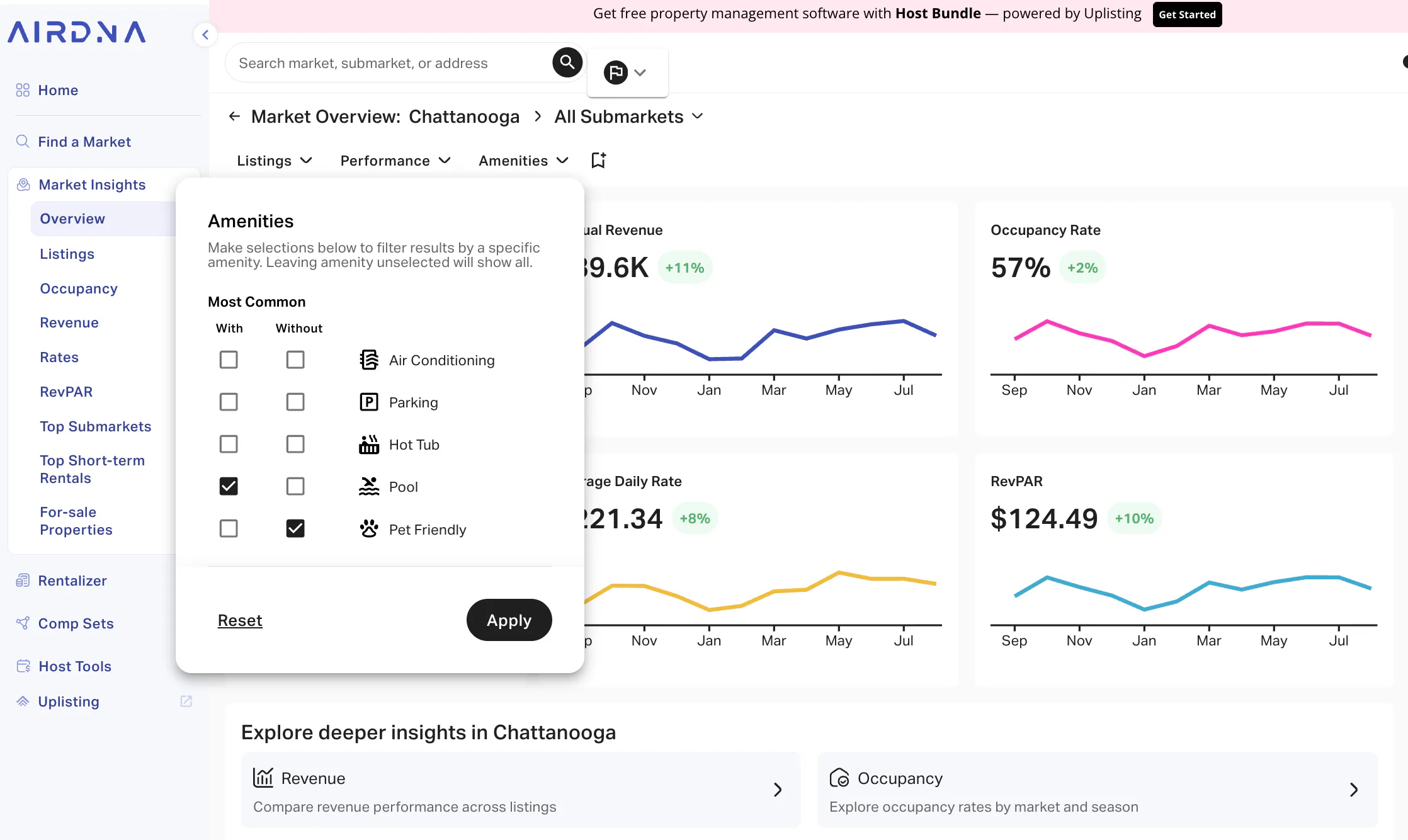
Consider adding short-term rental properties that align with what you plan on offering to a custom comp set with AirDNA. See in aggregate what those listings are charging and how their performance has changed over time.
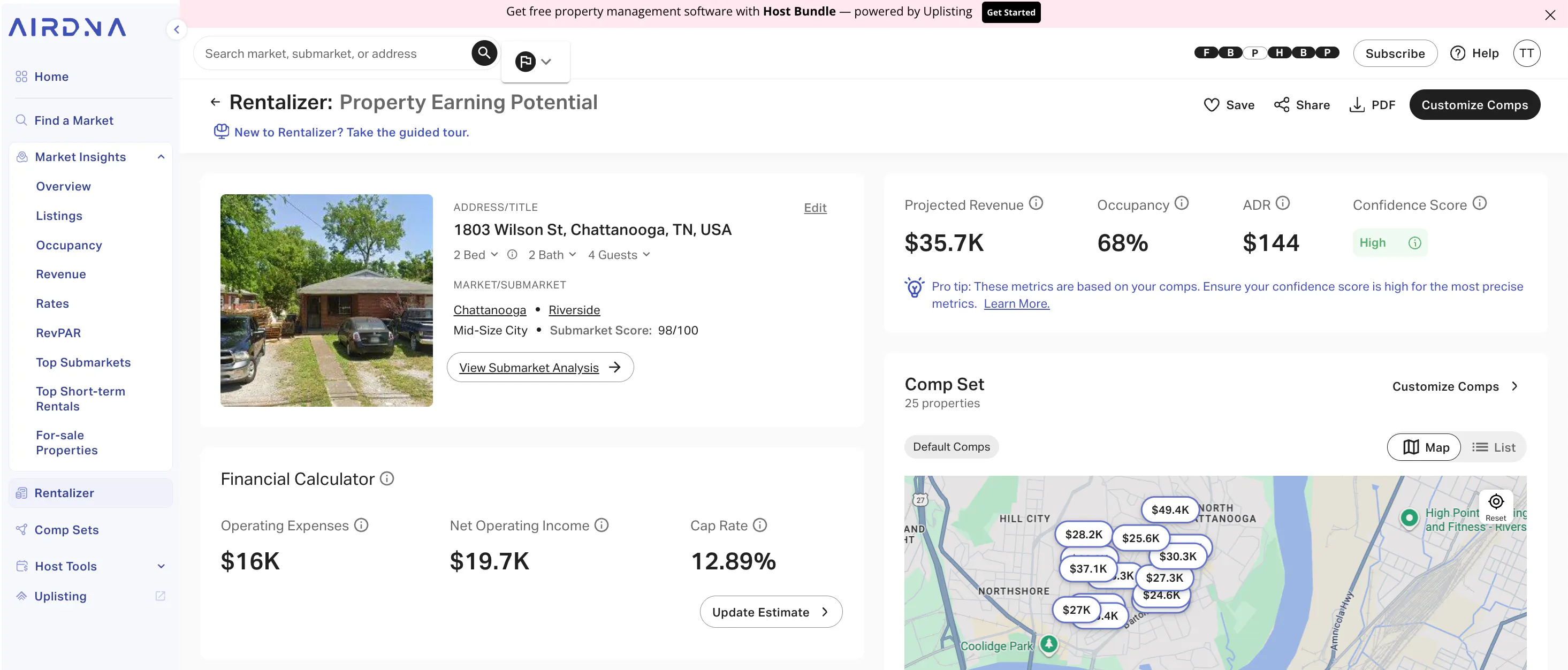
Once you’ve done your homework on what types of listings are performing well in your area down to a submarket level, you can start searching for properties. As you find opportunities, use AirDNA’s Airbnb Calculator to calculate the earning potential of those addresses.
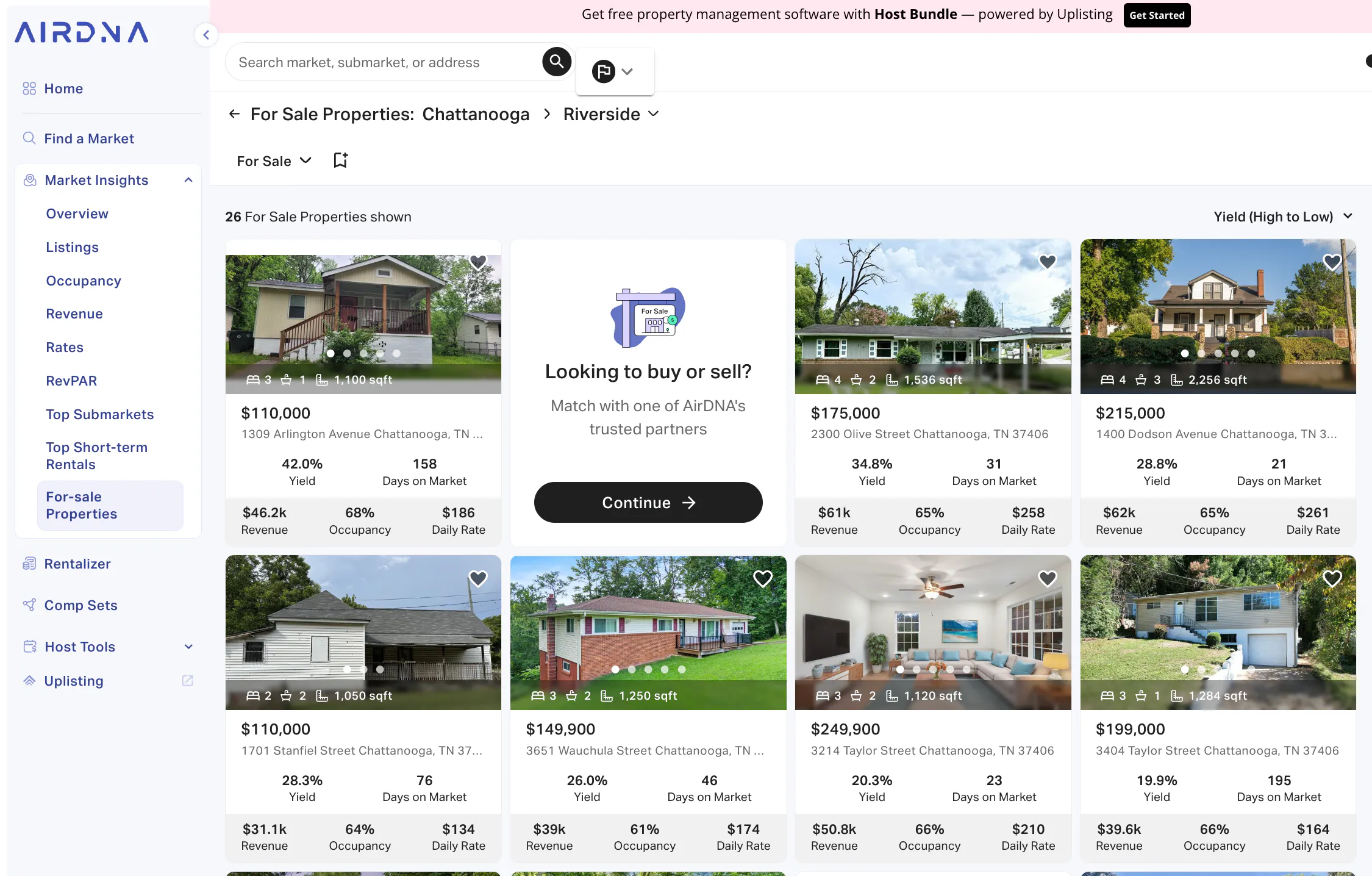
Suppose you don’t have a particular property in mind. In that case, the short-term rental market search feature in the AirDNA dashboard can show you for-sale properties in any given market, along with their projected performance.
Real estate, regardless of market conditions, remains one of the smartest investments on planet earth. The differences between owning a second home and operating a financially successful short-term rental property, though, cannot be understated.
Step 4: Create Your Short-Term Rental Financing Plan
Once you’re satisfied with your investment thesis, this next step is all about due diligence.
Investing in real estate is likely one of the most significant financial commitments you’ll make in your lifetime, with potentially hundreds of thousands or millions of dollars at risk. Make sure you fully understand what you’re signing up for.
A financing plan must match both your property goals and your financial profile. This plan is more than just choosing a loan. It’s about aligning risk, market realities, and data to secure the right funding and protect your long-term returns.
Assess risk tolerance for STR financing
Every financing plan begins with an honest look at how much risk you’re willing to take on. Are you comfortable leveraging higher debt for the potential of bigger returns, or do you prefer a more conservative approach with lower monthly obligations?
Investors use return on investment (ROI) metrics to quantify this:
- Cap rate shows how profitable a property is based on income and purchase price, regardless of financing.
- Yield gives a similar snapshot, typically as gross or net income relative to property value.
- Cash-on-cash return incorporates financing costs, making it the most directly relevant metric for your loan choice. A property may look great on cap rate but far less attractive once you factor in debt service from a high-interest loan.
This is where financing products enter the picture. Choosing between a conventional loan, a DSCR loan, or a higher-leverage option changes your cash-on-cash return, which in turn helps you decide whether the investment matches your comfort level with risk.
Understand STR market performance for financing
Second, you need to understand the markets you are investing in, which you’ll have touched on while developing your investment thesis. Market performance tells you how much financing your property can realistically support. Self-educate on the key metrics for your target markets:
- Average Daily Rates (ADR)
- Occupancy rates
- Revenue per Available Rental (RevPAR)
- The general cost of homes in the area
- How seasonality influences your monthly and annual revenue
- How local or state regulations can help or hinder your Airbnb operation
By mapping these market metrics against your financing options, you’ll know whether the property’s income potential is enough to comfortably cover debt obligations.
This is also the time to evaluate micro and macro trends that could impact your investment. We have a guide to short-term rental market analysis dedicated to this very topic.
Use data to secure better STR financing
Finally, data is what turns your financing plan from a guess into a business case. Lenders and partners want proof that your property can perform.
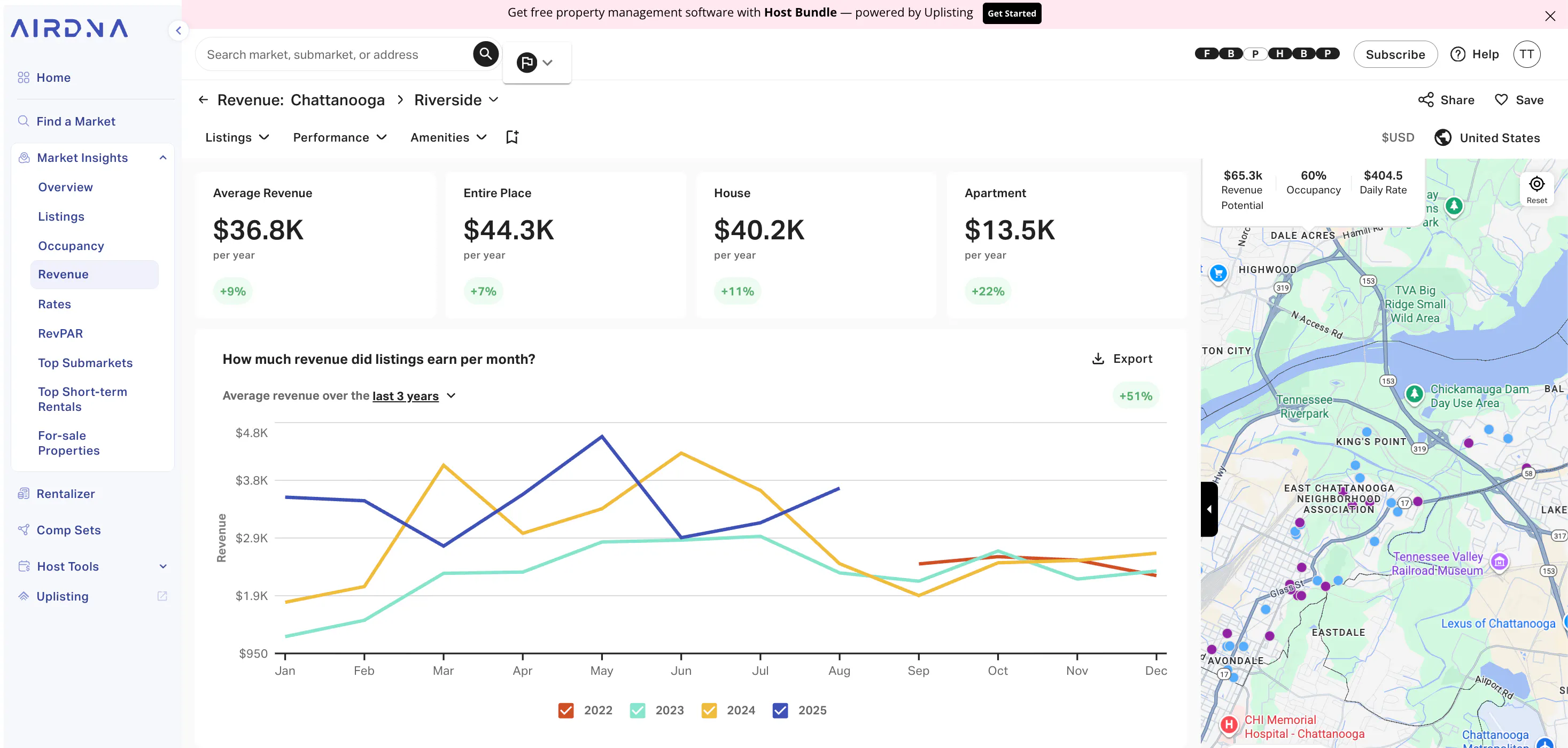
With AirDNA, you can gain access to historical performance data dating back as far as 2018 as well as forward looking data at how much guests are willing to pay up to 6 months into the future. The metrics that make the initial investment attractive could improve or worsen over time. This is precisely why a data tool is one of your best insurance policies.
Presenting this data to stakeholders can:
- Improve your chances of loan approval.
- Help you secure lower interest rates or better terms.
- Give you confidence that your financing plan remains viable as market conditions change.
In short, data validates your financing plan. It demonstrates to both you and your lenders that your STR is financially sound.
Step 4: Choose the Right Short-Term Rental Loan
There’s a variety of options when it comes to financing your vacation rental mortgage. Below, we highlight your best bets for short-term rental loans.
Traditional financing for short-term rentals
Conventional loans are the most common type of mortgage. They’re backed by Fannie Mae and Freddie Mac and offered by banks and credit unions. They can be used to purchase a primary residence or an investment property, but the rules differ depending on how the property will be used.
- Primary residence loans generally offer the lowest rates and down payment options (as little as 3–5%), but the buyer must live in the property as their main home. Some investors use “house hacking” strategies to access these favorable terms, which entails living in one unit and renting out another.
- Investment property loans carry stricter requirements: larger down payments (often 15–25%), higher interest rates, and stricter credit standards. Lenders want to see strong borrower financials since the loan isn’t tied to the buyer’s own housing.
For first-time STR buyers, a conventional investment loan is often the starting point. It offers some of the best available rates but comes with scalability challenges. Each loan approval is tied closely to your personal income and debt-to-income ratio, which can limit portfolio growth over time.

Debt Service Coverage Ratio (DSCR) Loans
Unlike a traditional loan, asset-based loans are evaluated by looking at the actual or potential income of a given property (e.g., rental income). Asset-based loans for investment properties are also known as commercial rental-specific loans or debt service coverage ratio (DSCR) loans.
Lenders look at the income of the property and calculate the debt service coverage ratio: the property income divided by the principal, interest, taxes, insurance, and HOA fees (if applicable), to qualify the loan.
This type of short-term rental loan is a significant advantage to an STR investor because borrowing power is not constrained by individual income. The investor can scale a portfolio and add new properties by simply providing sufficient evidence that the properties are cash-flowing and that there is sufficient equity for the down payments and associated fees.
Potential downsides include higher down payments, typically 20-25%, and higher rates than traditional loans. We have an entire article dedicated to DSCR loans if you’re interested in learning more!
Hard money loans for short-term rentals
A hard money loan is a type of loan that is secured by real property. Hard money loans are considered loans of last resort or short-term bridge loans. These loans are primarily used in real estate transactions, with the lender generally being individuals or companies, not banks. Hard money loans are generally short-term, 1-3 years, and have higher interest rates and associated loan fees.
Alternative STR financing methods
The financing options listed above are some of the more common approaches, but there are multiple ways to creatively finance STRs:
- Home Equity Line of Credit: Investors with existing home equity may want to explore using a home equity line of credit (HELOC) or cash-out refinance on their existing primary home or other investment properties. These options allow the investor to tap into the equity they have accumulated in a given property and use that equity toward acquiring a new rental property.
- Private Financing: Other STR investors find success with private financing. This often takes the shape of an individual or individuals funding part or all of the purchase. The beauty of private financing is that you can work out your own terms between parties for loan payback or equity in the purchase.
- House Hacking: House hacking is the practice of getting a loan for a primary residence, which often has more favorable terms than an investment loan, and living there while you rent out part of the home as a vacation rental. This can be a room in your main home or a private space, like a basement unit.
Finally, it never hurts to talk to your bank. During the meeting, don’t talk about the loan terms you’re looking for. Instead, tell them about the investment you’re looking to make and what you intend to do with the property.
For instance, let’s say you’re buying a rundown property in a popular neighborhood with the intention of rehabbing it and thus raising its value. The bank may have a specific loan product that fits your needs that you never knew existed.
Our article on the Best Loans for Investment Properties covers the options outlined above, and more, in greater detail.
Forecasting Short-Term Rental Financing Trends Into 2026
After exploring the major loan types available to STR investors, it’s important to look ahead. Loan products don’t exist in a vacuum. They evolve alongside broader housing and rental market conditions. As we move from 2025 into 2026, several financing trends are set to shape how investors approach STR acquisitions.
1. DSCR loans gaining traction
Debt Service Coverage Ratio (DSCR) loans are expected to become even more popular as lenders grow more comfortable with income-based underwriting. With occupancy and revenue performance hitting record highs in many U.S. markets in recent months, lenders are more confident in the reliability of STR income streams. Expect to see competitive DSCR products dipping below 7% interest for borrowers who can demonstrate strong and consistent cash flow.
2. Data-driven underwriting becomes the norm
AirDNA’s growth outlook shows that demand for unique stays and secondary markets is rising, while revenue management is becoming increasingly sophisticated. Lenders are taking note. Many will require more granular proof of earnings, such as dynamic pricing histories and forward-looking booking data. Investors who use tools like AirDNA’s Revenue Calculator and Market Score will have an edge in securing financing, as these data points align with how underwriters now evaluate risk.
3. Refinancing windows opening
With mortgage rates trending down from their 2023 peak, refinancing opportunities are expected to increase. Investors who secured higher-rate loans in recent years may be able to restructure debt at more favorable terms in 2026, freeing up capital for portfolio growth.
4. Greater emphasis on adaptive management
Finally, financing strategies will increasingly hinge on strong property management. Lenders recognize that investors who actively adjust pricing, market across platforms, and reinvest in property upgrades are better positioned for long-term success. Expect financing approvals to more frequently factor in an operator’s management track record, not just property-level performance.
The bottom line: Investors who embrace data-driven decision making and focus on resilient, year-round STR assets will be best positioned to secure competitive financing in 2026.

Choosing the Right Short-Term Rental Financing Lender
Picking the ideal lender can be the key to unlocking your investment’s full potential.
Here are key factors to consider when choosing a short-term rental mortgage lender:
- Reputation and experience: Look for lenders with a strong track record in STR financing and positive customer reviews.
- Loan options: Ensure they offer various loan types, such as conventional, asset-based, and hard money loans.
- Interest rates and terms: Compare interest rates, loan terms, and repayment options to find the most favorable conditions.
- Customer service: Evaluate their customer support and willingness to provide guidance throughout the financing process.
- Flexibility: Check for flexible loan requirements and terms that align with your financial situation and investment goals.
Host Financial is a top choice for STR financing. They specialize in vacation rental financing, offering tailored loan options with flexible terms for short-term rental property investors.
Cash Reserves for Short-Term Rental Financing
Don’t just consider the purchase price and loan terms when financing a short-term rental property. You also have to maintain adequate cash reserves for a successful STR operation.
Cash reserves are funds set aside to cover unexpected expenses, periods of low occupancy, or major repairs.

Here's why cash reserves are essential for short-term rental property loans:
- Financial buffer: Cash reserves provide a safety net during periods of low occupancy or unexpected market downturns. This can help you meet mortgage payments and other obligations even when rental income is lower than anticipated.
- Emergency repairs: Short-term rentals typically experience more wear and tear than long-term rentals. Cash reserves ensure you can quickly address any maintenance issues or necessary upgrades without disrupting your rental schedule.
- Seasonal fluctuations: Many short-term rental markets experience significant seasonal variations in demand. Cash reserves can help you manage cash flow during off-peak seasons.
- Regulatory changes: The short-term rental landscape is constantly evolving. Cash reserves can help you adapt to new regulations that may require property modifications or changes to your business model.
- Marketing and upgrades: Having cash on hand allows you to invest in marketing efforts or property improvements that can boost your rental's appeal and income potential.
- Lender requirements: Many lenders require borrowers to demonstrate cash reserves as part of the loan approval process. This shows you have the financial stability to manage the property effectively.
So, how much should you keep in cash reserves? While this can vary based on your specific situation, a general rule of thumb is to maintain at least 3-6 months of operating expenses and mortgage payments in easily accessible funds. Some investors prefer to keep even more on hand, especially for properties in highly seasonal markets or areas prone to natural disasters.
Remember, adequate cash reserves are not just a safety measure—they're a crucial component of successful short-term rental investing. They provide the financial flexibility to weather challenges and capitalize on opportunities, ensuring the long-term sustainability and profitability of your investment.
Key Metrics for Better STR Financing
Below are some of the key metrics that any investor should review when considering a potential short-term rental mortgage investment:
- Rental income: One of the most important factors in securing an STR mortgage for rental property lenders is short-term rental revenue. How much will your rental property earn per month and per year? This is the most basic metric to calculate a property’s future return on investment (ROI).
- Occupancy Rate: Occupancy Rate = Total Booked Days / (Total Booked Days + Total Available Days). Occupancy is the percentage of available nights an STR is booked in a given month. The higher the occupancy, the more revenue the property will generate.
- Capitalization Rate: Cap rate = the ratio of net operating income (NOI) to property asset value. For example, if a property recently sold for $1,000,000 and had an NOI of $100,000, then the cap rate would be 10% ($100,000/$1,000,000).
- FICO Score: Your FICO Score is by far one of the most important factors impacting your ability to obtain affordable short-term rental financing. A FICO credit score tells lenders about your creditworthiness, or how likely you are to pay back a loan based on your credit history. It’s calculated using the information in your credit reports. FICO scores are the standard for credit scores and are used by 90% of top lenders.
- Debt-to-Income (DTI): DTI is calculated by dividing your monthly debt payments by your monthly gross income. Lenders use it to determine your riskiness as a borrower. It helps determine how well you manage monthly debt obligations and if you can afford to repay the loan.
- Debt Service Coverage Ratio: The debt service coverage ratio (DSCR) measures the viability of a real estate deal. It measures your ability to use cash flow to pay current debt obligations. It’s calculated by dividing income by PITIA (Principal, Interest, Taxes, Insurance, and HOA Fees) to get a ratio of income to cost.

Short-Term Rental Financing FAQ
What is the bridge method in STR financing?
The bridge method in short-term rental financing refers to using a short-term loan (a "bridge loan") to quickly purchase a property, with the intention of refinancing to a long-term mortgage later.
This method can be useful when:
- You need to act fast to secure a property in a competitive market.
- You plan to renovate the property before refinancing.
- You don't currently qualify for a traditional mortgage, but expect to in the near future.
Bridge loans typically have higher interest rates and shorter terms (6-18 months) compared to traditional mortgages. The goal is to "bridge" the gap between the property purchase and long-term financing. While this method can provide flexibility, it also carries risks, particularly if you're unable to refinance as planned.
Can you really make money with short-term rental financing?
Yes! Short-term rentals can be a lucrative business venture. Success is not guaranteed, though, and depends on various factors:
- Location: Properties in high-demand tourist areas or business hubs often perform better.
- Property management: Effectively managing bookings, cleaning, and maintenance is crucial.
- Pricing strategy: Dynamically adjusting prices based on demand can maximize revenue.
- Guest experience: Positive reviews and repeat guests can boost occupancy rates.
- Seasonality: You’ll need to understand and plan for seasonal fluctuations in demand.
- Regulatory environment: Compliance with local short-term rental regulations will protect your business.
- Financial management: Properly account for all expenses, including mortgage, taxes, and maintenance.
While some investors report higher returns fromshort-term rentals compared to long-term rentals, it's important to note that short-term rentals often require more active management and can have more variable income streams. Careful market research and financial planning are crucial for success.

Can you use a DSCR loan for Airbnb?
Yes, you can use a debt service coverage ratio (DSCR) loan for an Airbnb or other short-term rental property.
DSCR loans are becoming increasingly popular for short-term rental investors because:
- They focus on the property's income potential rather than the borrower's personal income.
- They often have less stringent qualification requirements compared to traditional mortgages.
- They can be used for non-owner-occupied properties, which is common for short-term rentals.
With a DSCR loan, the lender calculates the ratio of the property's net operating income to its debt obligations. If this ratio is high enough (typically 1.25 or higher), you may qualify for the loan even if you wouldn't meet the income requirements for a traditional mortgage.
However, keep in mind that DSCR loans often come with higher interest rates and may require larger down payments compared to conventional mortgages. Additionally, lenders may use more conservative estimates of short-term rental income when calculating the DSCR, given the potential volatility of this market.
How do I reduce down payments for STR properties?
While many lenders require a 20% down payment for investment properties, including short-term rental properties, there are several strategies you can use to potentially reduce this requirement for your vacation rental financing:
- FHA Loans: If you plan to live in one unit of a multi-unit property and rent out the others, you might qualify for an FHA loan with as little as 3.5% down.
- House hacking: Similar to the FHA strategy, you could purchase a property as your primary residence (which often requires a lower down payment) and rent out rooms or a portion of the property.
- VA Loans: If you're a veteran or active-duty military, you might qualify for a VA loan with 0% down, even on multi-unit properties if you live in one unit.
- Portfolio lenders: Some portfolio lenders offer investment property loans with lower down payment requirements, especially if you have a strong credit profile or other assets.
- Private money or hard money lenders: These lenders may offer more flexible terms, including lower down payments, though often at higher interest rates.
- Home equity: If you have significant equity in your primary residence, you could potentially use a home equity loan or HELOC to fund the down payment.
- Seller financing: In some cases, the property seller might be willing to finance part of the purchase price, reducing your out-of-pocket down payment.
- Partnership or syndication: Partnering with other investors can help you pool resources for the down payment.
What are the disadvantages of short-term financing?
One major drawback is the higher interest rate often charged to offset lenders’ perceived risk. These shorter repayment periods can substantially increase monthly payments, and amending loan terms can lead to higher total interest owed.
Balloon payments or early payoff penalties are also common, making it crucial to check a lender’s fine print. Additionally, properties in volatile or highly seasonal markets may face tougher scrutiny from lenders when projecting rental income.
How much money down do I need to buy a rental property?
Down payments for short-term rental properties generally range from 15% to 25%, though some lenders require more if the property’s rental income is deemed riskier. DSCR loans, for instance, can demand between 20% and 30% depending on credit scores and projected vacancy rates.
Conventional mortgages often offer lower down payments but require proof of stable personal income. Exploring options like FHA loans or house hacking can reduce your up-front costs if you plan to occupy part of the property.

This blog was written with assistance from Host Financial’s Adam Windham:
Adam Windham is the co-founder and CEO of Host Financial, an industry leader in lending and capital advisory services for the STR space. Adam has over 15 years of experience in the real estate industry, both as a developer and investor, and he leverages that experience to help clients structure and finance their investments for the highest possible degree of success. Adam holds an MBA in Real Estate Finance and a Bachelor’s degree in Construction Management from California Polytechnic State University in San Luis Obispo, California.
ARTICLE SUMMARY
This guide provides essential steps and tips for financing a short-term rental property, from assessing the economic climate to choosing the right lender and loan type.
Bram Gallagher
AirDNA Director of Economics and Forecasting
Bram Gallagher is an Economist at AirDNA, specializing in uncovering insights that drive smarter short-term rental decisions. He put his Ph.D. in Economics from the University of Georgia to work researching and forecasting hotel data with CBRE prior to joining AirDNA, as well as teaching economics at a number of universities. In his spare time, Bram enjoys making wooden furniture with hand tools.