

 Calculate Revenue
 Research Markets
 Find For Sale Properties
 Compare My Listing
 STR Revenue Calculator
 Custom Comp Sets
 Submarket Insights
 Custom Search Filters
 Rate Recommendations
 Performance Benchmarking
 Competitor Comparison
 Owner Contact Details
 Property-level performance data
 Tourism Insights
 Real Estate Investment Analytics
 About Us
 Sales
Sales Support
 Press
PressAirbnb Cleaning Fees: What Hosts Need to Know in 2026 🧹
Published: July 22, 2025
Last updated: May 6, 2026

Camilo Schmid Rivas
Key Takeaways
- An Airbnb cleaning fee is a one-time charge that covers turnover tasks like laundry, cleaning, and restocking. It’s set by the host and added to the booking total.
- In 2025, the average Airbnb cleaning fee in the U.S. is $161.10 per stay—the highest globally.
- Use AirDNA’s interactive cleaning fee dashboard (below) to explore local trends, including average fees by bedroom count and the percentage of listings that charge a cleaning fee in your area.
Cleaning fees are one of the hottest—and most polarizing—topics in the vacation rental world. For some guests, they’re a reasonable charge for professional upkeep. For others, they feel like a surprise add-on that inflates the price after they've already fallen in love with a listing.
Like it or not, cleaning fees play a major role in shaping guest expectations, reviews, and booking behavior. If you're not thinking strategically about how and whether to charge them, you could be leaving money or guest satisfaction on the table.
In the U.S., nearly 9 out of 10 listings now include a cleaning fee. Cleaning fees have become a standard feature in how most listings are priced on Airbnb, so you’ll want to know if your price is right in 2025. Thankfully, we’ve got you covered.
What Are Airbnb Cleaning Fees?
An Airbnb cleaning fee is a one-time charge that hosts can add to help cover the cost of cleaning their short-term rental between guests. This fee goes directly to the host—not Airbnb—and helps pay for things like time and labor, laundry, sanitizing surfaces, and restocking essentials.
The typical tasks covered by an Airbnb cleaning fee are:
- Changing and washing linens and towels
- Sanitizing bathrooms and kitchen surfaces
- Vacuuming and mopping floors
- Taking out trash and recycling
- Dusting furniture and fixtures
- Restocking toiletries and household essentials
For a complete look at what a thorough turnover should include, check out our Ultimate Short-Term Rental Cleaning Checklist.
How Does Airbnb Charge Cleaning Fees?
Hosts can charge cleaning fees on top of the base price or they can bundle cleaning costs into their nightly rates. When cleaning costs are included as a separate fee, they’re listed separately from Airbnb’s service fees and optional add-ons during check-out. Unlike the security deposit, hosts don’t return the cleaning fee at the end of the guest’s stay.
The standard cleaning fee approach is a flat one‑time fee regardless of stay length, but Airbnb now lets hosts offer a lower short-stay rate for 1-2 night bookings. If hosts want more granular control over their cleaning fees, like setting variable rates for different stay lengths or pet fees, that usually requires third‑party PMS or revenue‑management software capable of dynamic fee rules. A PMS like Uplisting can integrate directly with a tool like PriceLabs to offer complete control over cleaning fees.
Guests see the total per-night rate with fees already baked in as they browse listings, making pricing more transparent and easier to compare. In the past, Airbnb guests often didn’t see the full price until checkout, leading to a surprise when the total popped up hundreds of dollars higher than the nightly rate alone. That all changed in April 2025, when Airbnb made the total price display mandatory globally.
That change isn’t just cosmetic. Airbnb’s search algorithm explicitly evaluates total price competitiveness when ranking listings. Properties with clear, reasonable all-in cleaning prices often rank higher. While cleaning fees themselves aren’t penalized, excessive fees—especially on short stays—can make a listing look overpriced and reduce both visibility and conversion.
How Much Is the Average Airbnb Cleaning Fee?
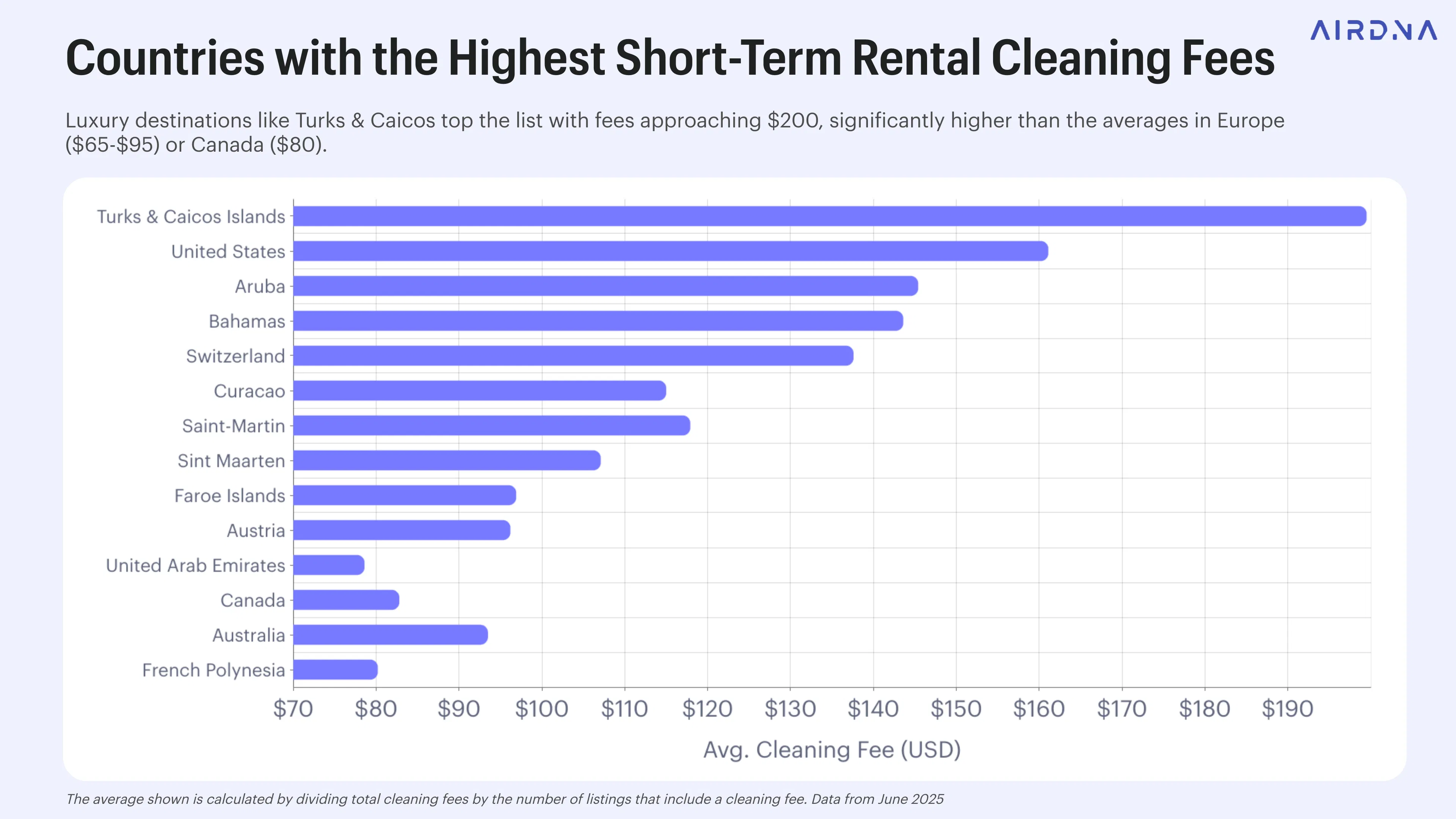
In the U.S., the average Airbnb cleaning fee in 2025 is $161.10 per stay—the third highest of any country, according to AirDNA data.
We calculate the average cleaning fee by dividing cleaning fee earnings in a given market by the number of listings that collect a fee. Some listings in a market don’t have cleaning fees at all and they’re excluded from the calculation.
What’s “typical” in other parts of the world really depends on where you’re hosting. In Canada and Australia, cleaning fees hover around $70, while most European markets land between $65 and $95. Fees are even lower in places like Mexico and Brazil, often closer to $50 or less. At the other end of the spectrum, luxury vacation destinations like the Turks and Caicos and the Cayman Islands see average cleaning fees approaching $200.
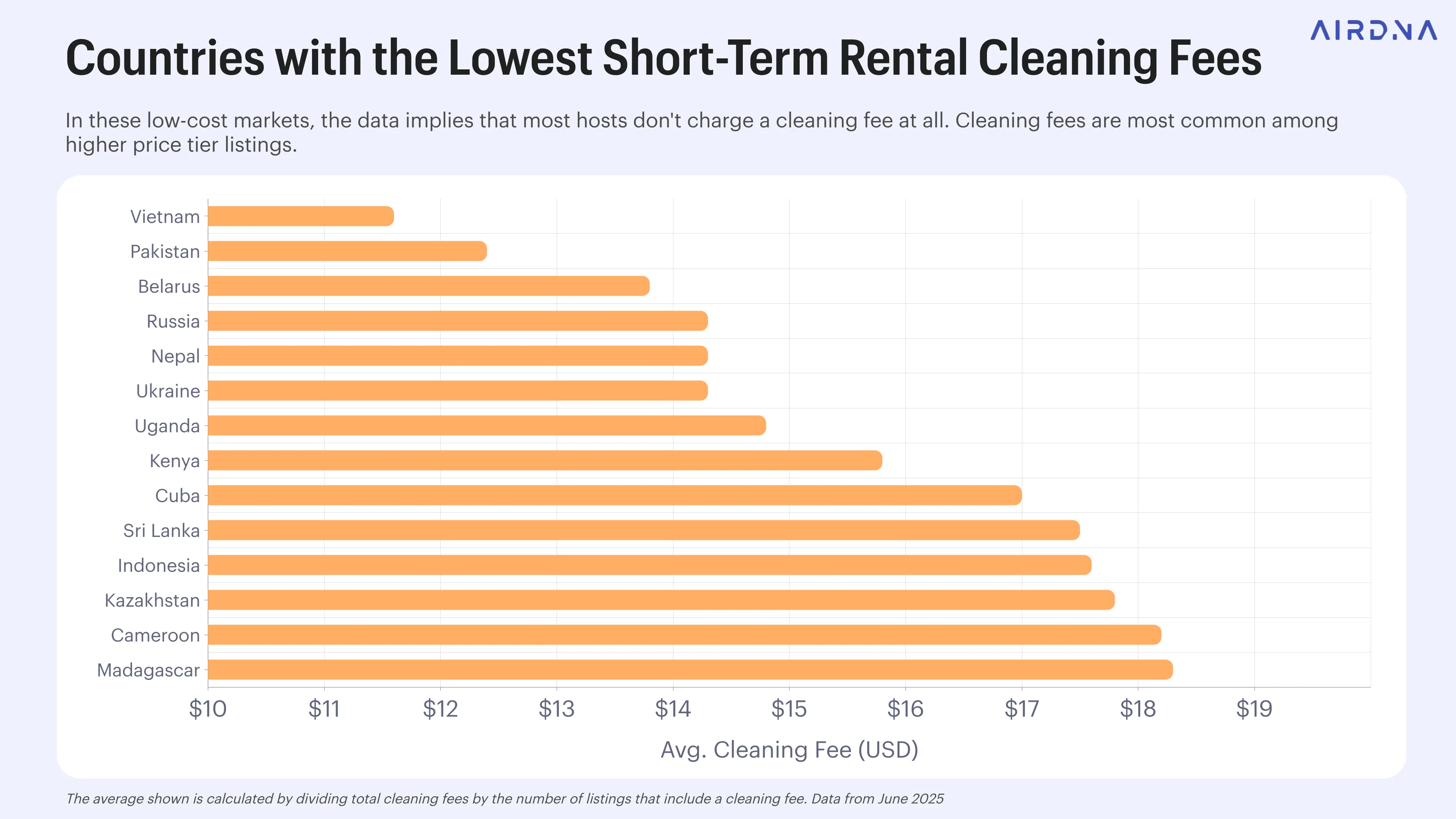
Opposite of luxury beach destinations, we have countries whose average cleaning fees fall under $5 USD per night. The lowest cleaning fees globally are concentrated in South Asia, Eastern Europe, and parts of Africa. India tops the list for lowest cleaning fees with an average of $6.90.
The average cleaning fee drops significantly if you divide cleaning fee earnings between all listings, meaning rentals with and without cleaning fees. In India, it falls to $2.90. This low average fee could indicate that a majority of listings don’t charge a fee at all. In areas where there is less tourism and short-term rental infrastructure, the listings that do charge cleaning fees are often luxury tier vacation rentals that appeal to international travelers.
In Belarus, for example, the average cleaning fee for the entire market is just $3.80 USD. If you look exclusively at listings that charge a cleaning fee, that average shoots up to $13.80. That big discrepancy implies that hosts who charge fees are likely charging higher nightly rates, too.
Despite big differences between markets, one thing is clear: Airbnb cleaning fees are rising. Between 2024 and 2025, nearly every country saw an increase in the share of listings with cleaning fees. This is likely driven by higher labor costs and growing guest expectations for spotless stays.
Should You Charge an Airbnb Cleaning Fee?
If you're hosting in the U.S., the answer is usually yes. Nearly 9 in 10 U.S. listings (89%) include a cleaning fee, and that number hasn’t changed since 2024. It’s one of the highest adoption rates in the world.
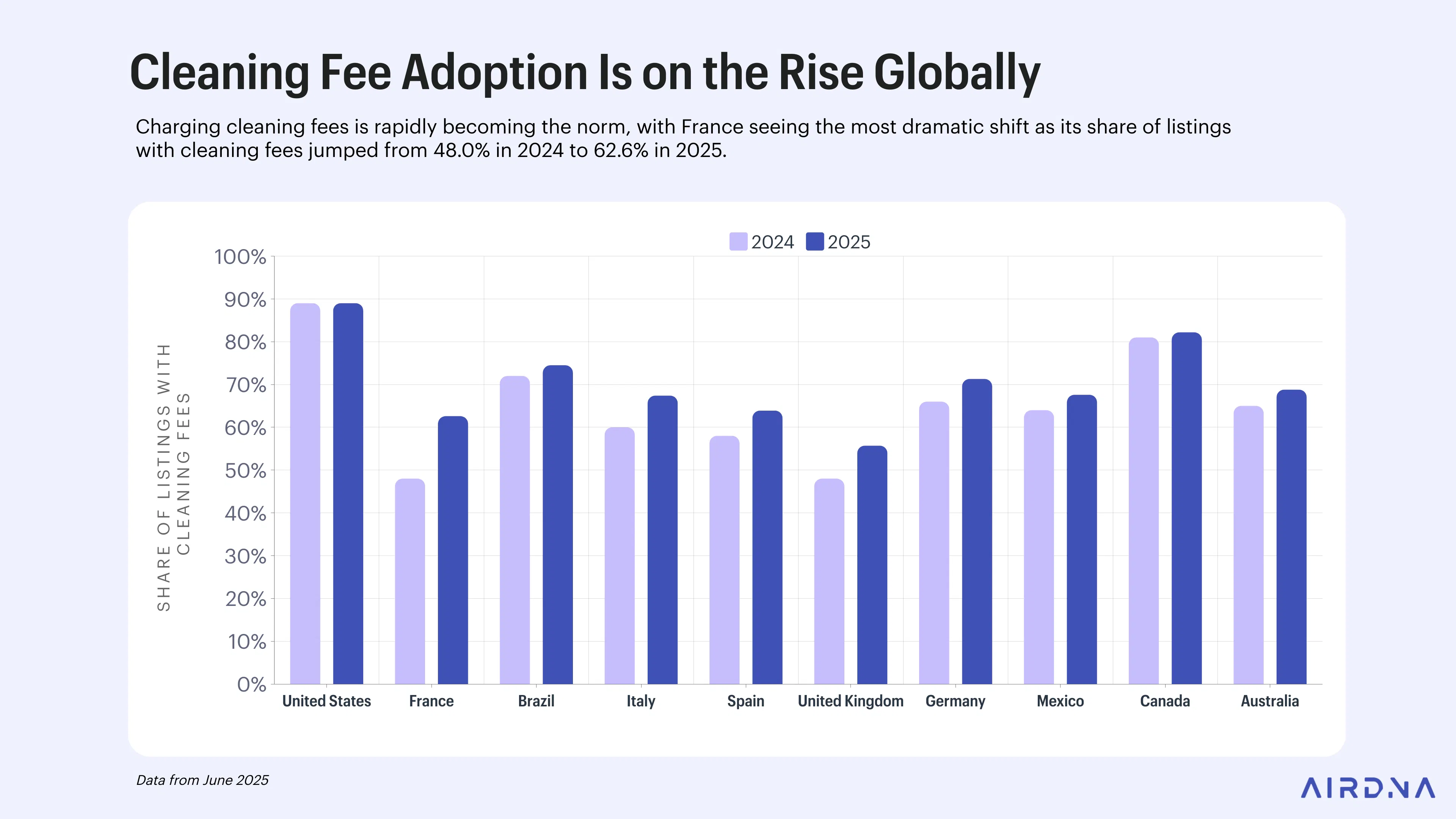
Cleaning fees aren’t universal, however. In many European countries, they’re only starting to become the norm. France saw the biggest shift in the last year, with the share of total listings that have cleaning fees rising from 48.0% in 2024 to 62.6% in 2025. Other European countries lag behind. Though over half of total listings in these countries have cleaning fees, it’s not a strong majority:
- Germany (51.1%)
- Italy (57.0%)
- U.K. (59.8%)
If you host across multiple countries, it’s worth checking what’s typical in each region.
So—should you charge an Airbnb cleaning fee? In most cases, yes. The real question is how much to charge. That number should reflect:
- Your actual cleaning costs
- Guest expectations in your area
- What similar listings are doing
Remember: most guest frustration comes from surprise, not the fee itself. If your pricing is competitive and clearly disclosed, you’re more likely to set expectations, protect your margins, and secure better reviews.
How Much to Charge for Airbnb Cleaning in 2025
In 2025, setting the right cleaning fee matters more than ever. Hosts are juggling higher cleaning and supply costs. If a fee feels too high, it might turn people away. Too low, and you could be losing money. The key is finding that sweet spot. In the sections that follow, we’ll walk you through 3 key strategies for determining an appropriate cleaning fee for both guests and your bottom line.
Benchmark by property size
If you’re not sure where to start with your Airbnb cleaning fee, your property’s size is the most practical place to begin.
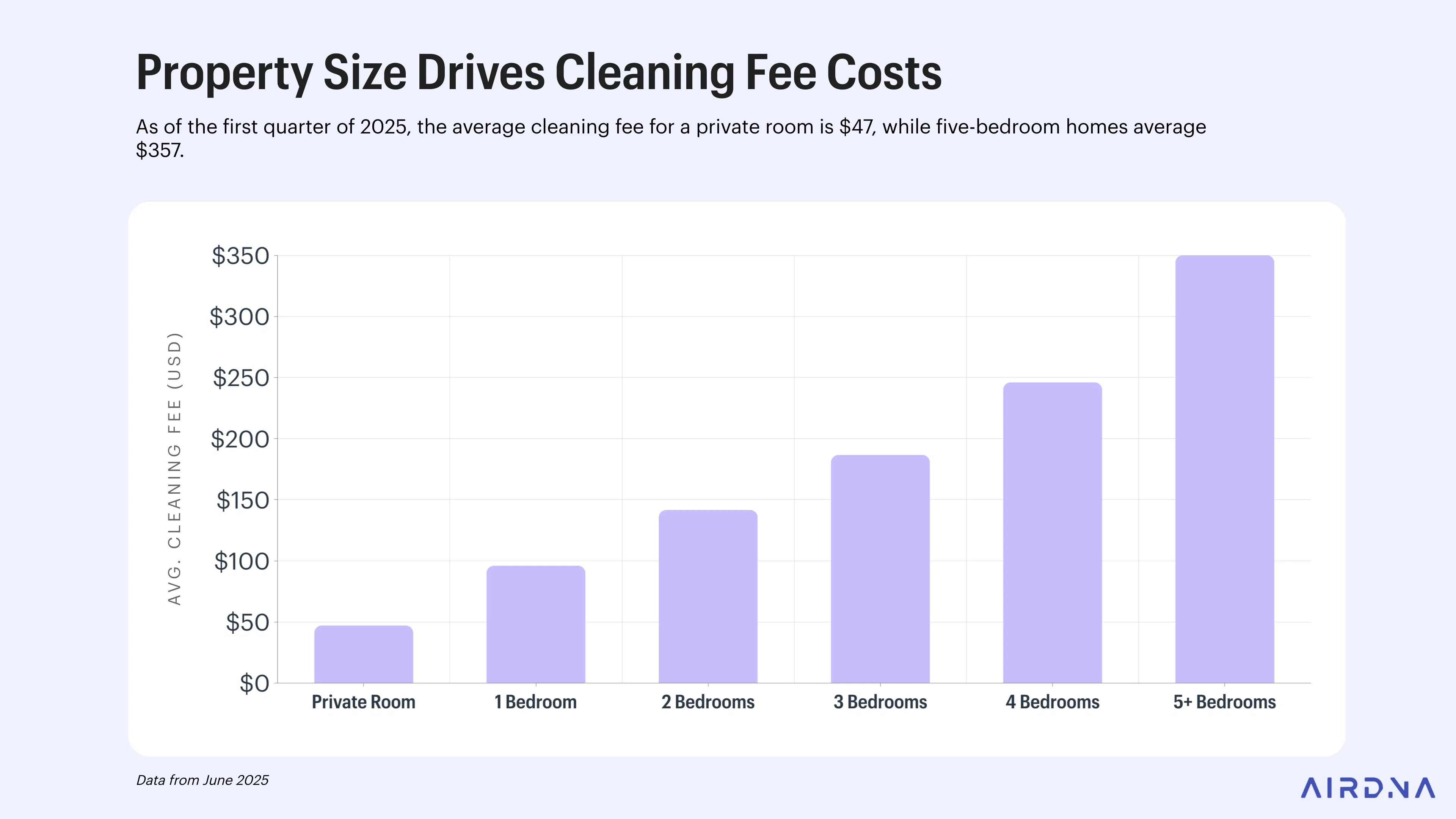
Larger properties naturally take more time, effort, and supplies to clean, so hosts need to charge more. As of the first quarter of 2025, the average cleaning fee for a private room is $47.10, while five-bedroom homes average $357.00. One-bedroom listings fall around $96.00 and two-bedrooms land at $141.60 per stay.
That means if you’re managing a two-bedroom and charging $70, you might be underpricing compared to your peers—and eating into your margins. On the other hand, if you’re running a studio with a $150 cleaning fee, you could be scaring off guests before they even check your calendar.
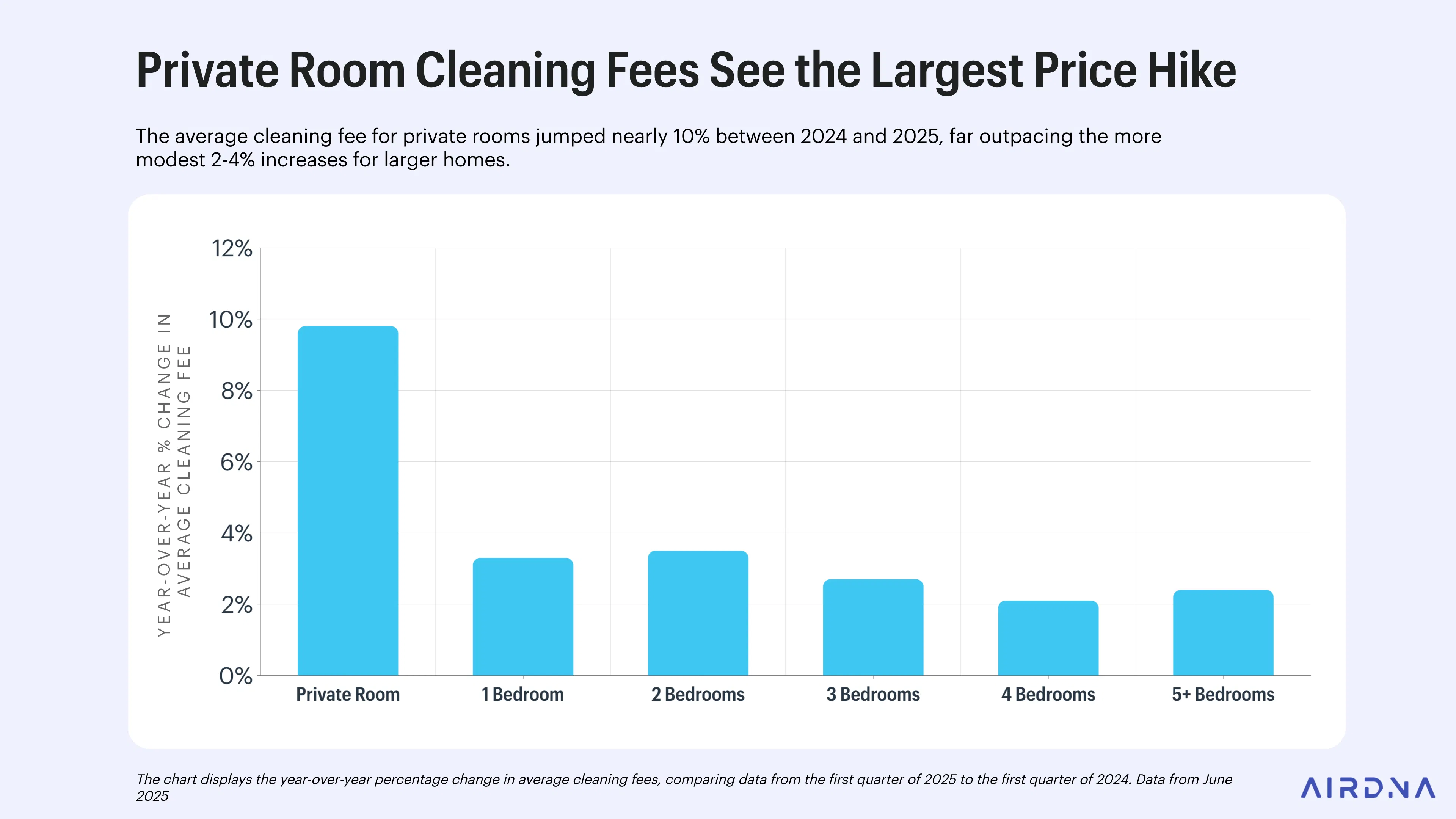
Benchmarking by property size shouldn’t be a one-time exercise. Cleaning fees are on the rise across property sizes, growing by an average of 4% between 2024 and 2025. Private rooms in particular have experienced the biggest jump in average cleaning fee (+10%), increasing from $42.90 in the first quarter of 2024 to $47.10 in the first quarter of 2025. Revisit your benchmarks annually to make sure you’re keeping up with the trends.
Make sure your cleaning fee covers your costs
Your cleaning fee should at least do one basic thing: cover your actual cleaning costs. That includes supplies, restocking essentials, and the time and labor of whoever cleans the property.
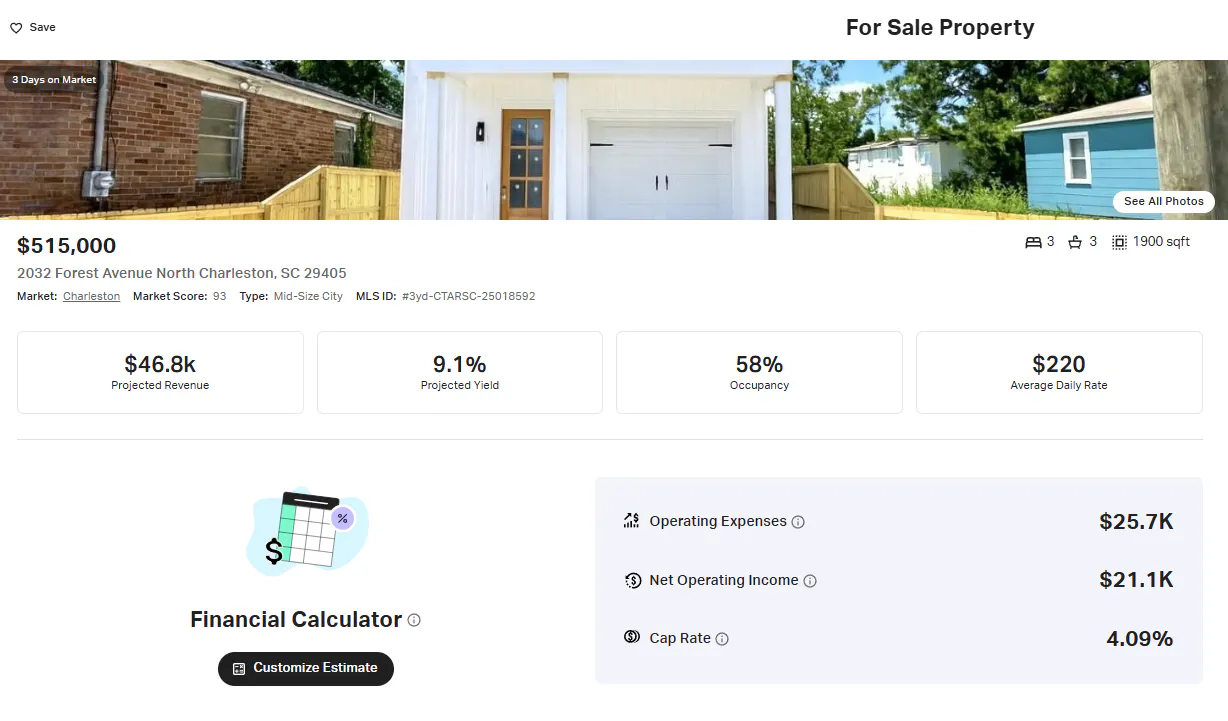
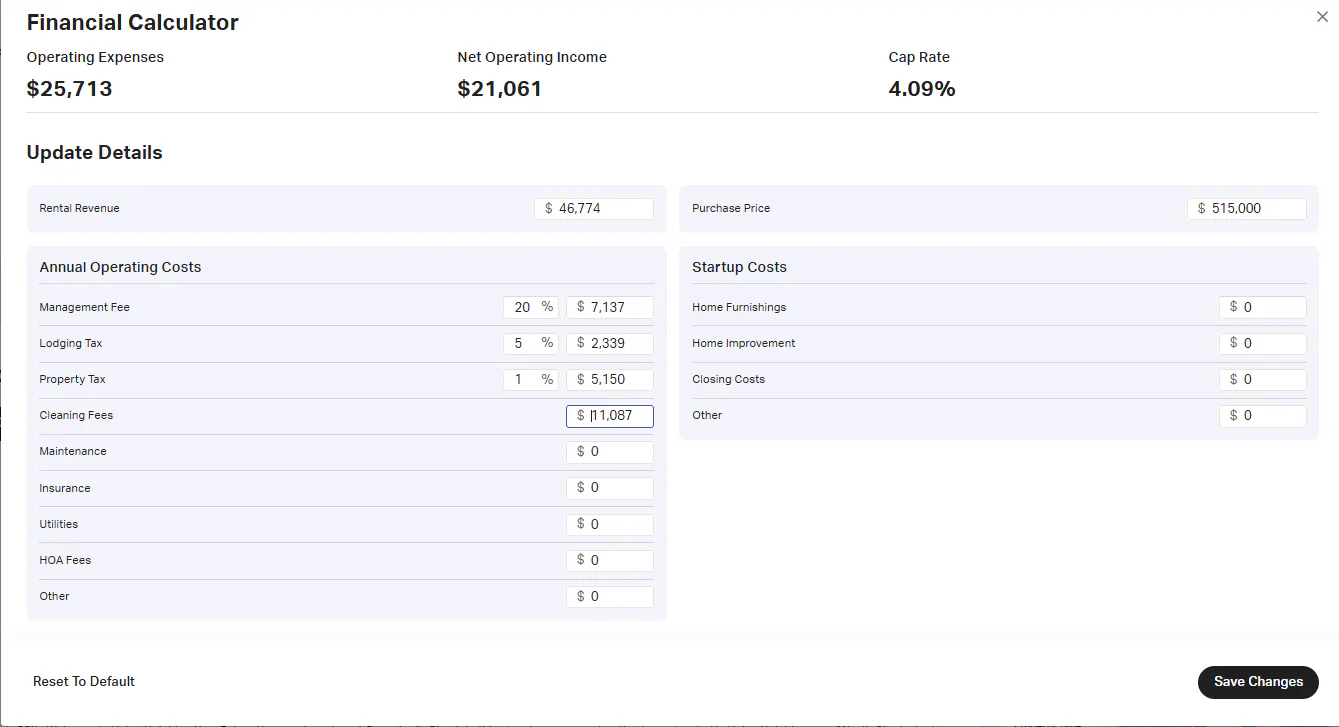
If you’re evaluating a new property or a home that’s listed for sale, the best place to start is with AirDNA’s Airbnb cleaning fee calculator, built into our Airbnb revenue calculator. Here's how it works:
- Enter any address to generate a revenue forecast powered by actual Airbnb and Vrbo data.
- The calculator pulls cleaning fees from comparable properties in that market to estimate what cleaning costs typically look like over the course of a year.
- This gives you a smart, data-backed sense of how much of your annual revenue is likely to go toward cleaning fees, which is useful for setting budgets and understanding operational costs up front.
Pro tip: You can also use this feature for properties listed for sale on platforms integrated with AirDNA. Just click on a listing to see an automatically generated financial forecast—including estimated cleaning fees—based on real comps.
If the property is already active on Airbnb and you’re trying to fine-tune your current cleaning fee, then the Airbnb revenue calculator isn’t the right tool. The estimate is based on what similar properties earn, not your actual earnings, so it may not reflect your true costs.
If you’re already running an Airbnb, then your best bet is to start with the real costs you’re incurring or expect to incur. Here’s how to get an accurate read:
- Contact local cleaning services and ask for quotes based on your property’s size, amenities (e.g., hot tub, large kitchen, multiple bathrooms), and turnover needs.
- Track your costs if you’ve already hired a cleaner. Include labor, supplies, mileage (if applicable), and time.
- Ask around in local host groups or forums. Other experienced hosts in your market can give you real-world benchmarks based on their own operations.
- Factor in frequency. A two-night stay can create just as much mess as a week-long stay. Consider your average stay length when pricing cleaning as a flat fee vs. bundling it into nightly rates.
Research your market
If you’re not sure what to charge for your cleaning fee or whether to charge one at all, start by looking around you—literally. Cleaning fees can vary a lot depending on where your property is located, how much local cleaners charge, and what guests expect in your area.
In some destinations, cleaning fees are a given. In others, they’re much less common. In Panama City, Florida and Corpus Christi, Texas, for example, 97% of listings include a cleaning fee. Charging one is standard practice.
In contrast, only 64% of listings charge a cleaning fee in places like Deep Creek, Maryland or Aspen/Snowmass, Colorado. That suggests a more nuanced local strategy. It may be that cleaning fees are more common among certain property types or within certain submarkets.
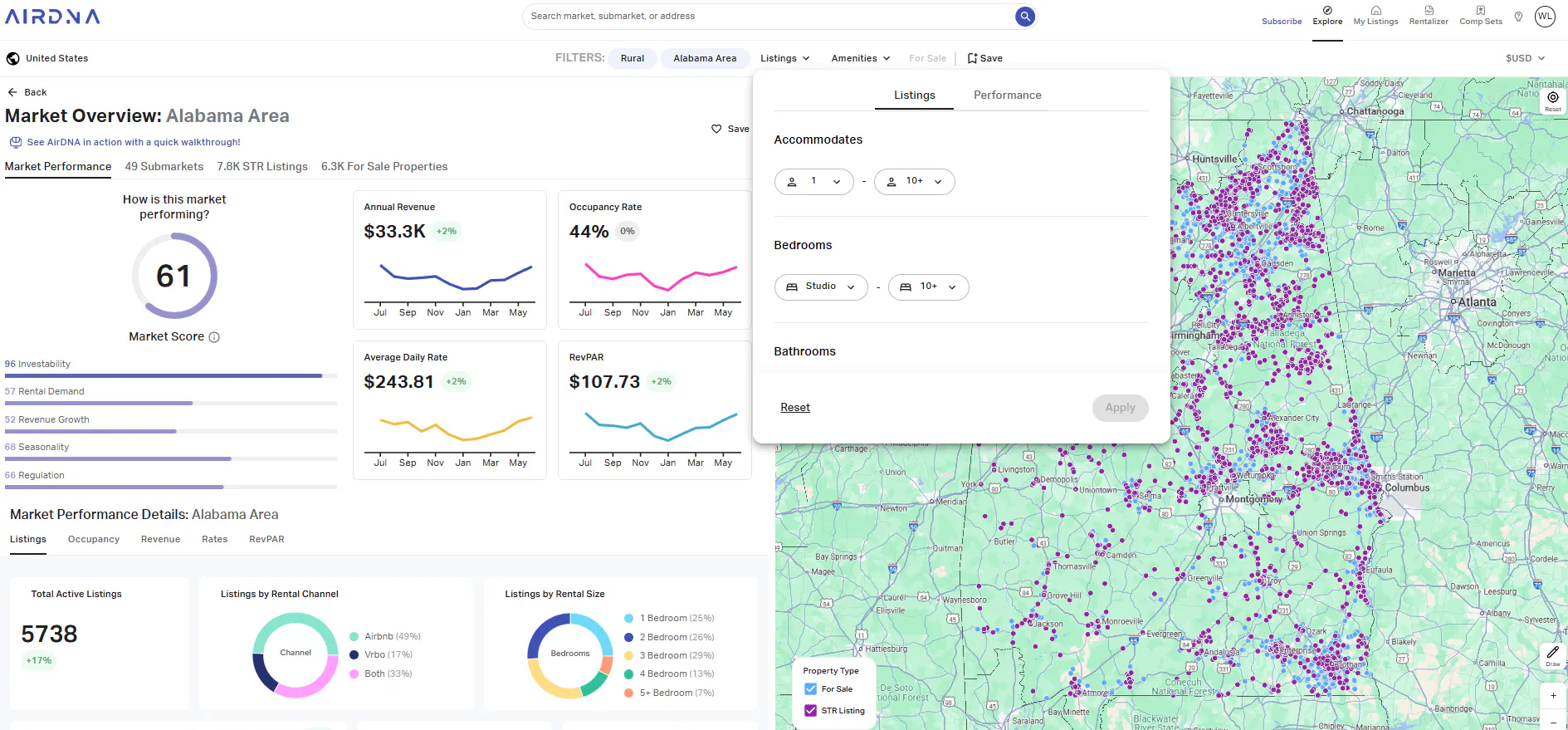
Once you know whether cleaning fees are common in your area, the next step is determining how much to charge. Use AirDNA’s cleaning fee dashboard below to explore:
- The average cleaning fee in your market
- Average fees by bedroom count
- The share of listings in your area charging a cleaning fee
Nationally, cleaning fees tend to be highest in destination/resort market types like Coastal and Mountain/Lake areas and lowest in Mid-Size City and Small City/Rural markets. The average cleaning fee in Coastal markets runs between $49 for private rooms to $421 for properties with 5 bedrooms or more. In Small/City Rural markets, that average cleaning fee range is $38 to $276.
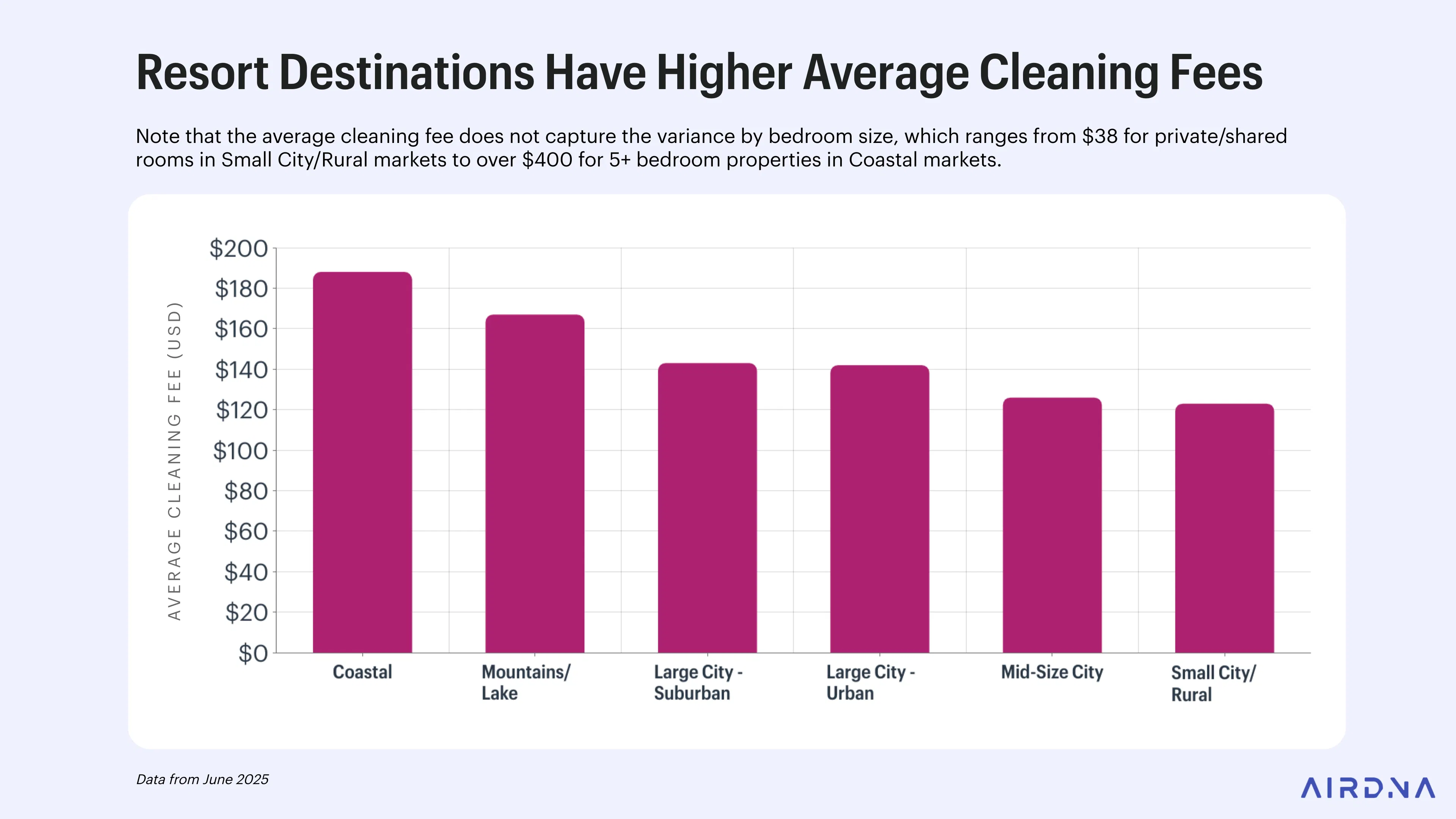
This variance in Airbnb cleaning fees showcases why copying another host’s cleaning fee—without knowing their market—can backfire. Guest expectations, labor rates, and cleaning standards can shift even a few miles apart. A beachfront condo might call for high-end turnover services. Meanwhile, a rental inland or near a business hub might attract longer stays with simpler needs.
Need help getting started? Use AirDNA to explore what other hosts in your submarket are charging by bedroom count and location. It’s one of the easiest ways to set a cleaning fee that’s both competitive and realistic.
See what your competitors are doing
When you’re deciding how much to charge for your cleaning fee, one of the best things you can do is look beyond market averages to similar listings in your area—this is called your comp set. A comp set is made up of properties that are like yours in size, style, and the kind of guests they attract. It gives you a realistic idea of what’s normal in your part of the market.
Inside AirDNA, you can build a custom comp set and instantly view each property’s average daily rate (ADR). Here’s the key: ADR already includes the cleaning fee. That means you’re seeing what guests are actually paying per night, not just the base rate.
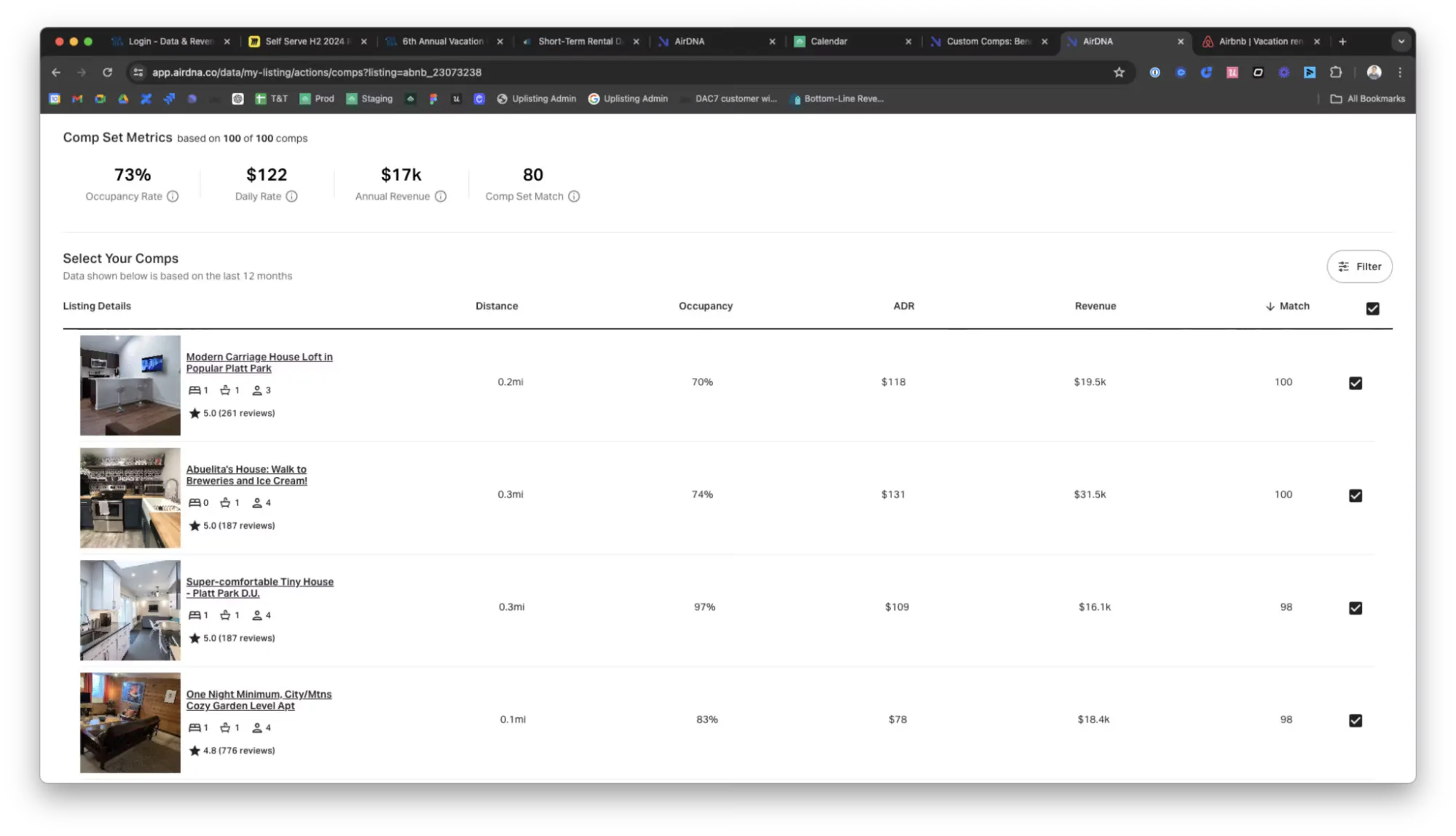
Looking at your comps helps you quickly gut-check whether your total nightly rate is in line with similar listings. If it’s significantly higher, it might be time to revisit your cleaning fee. If it’s lower, you could be leaving money on the table.
This isn’t about copying your competitors, though. It’s about understanding your position in the local market. If your property offers more value—like a hot tub, same-day turnover, or premium amenities—you may justify a higher rate. Just make sure your comp set reflects that level of quality, so you’re comparing apples to apples.
FAQs
What is an Airbnb cleaning fee?
An Airbnb cleaning fee is a one-time charge that hosts add to help cover the cost of preparing their space between guests. This can include washing linens, disinfecting surfaces, and restocking essentials. The fee is added to the booking total and goes straight to the host—not Airbnb. The usual cleaning fee approach is a flat one‑time fee regardless of stay length, but you can also offer a lower short-stay rate through Airbnb for 1-2 night bookings. If you’re a host who wants more control over your cleaning fees, you’ll need a third‑party PMS like Uplisting with revenue‑management integrations like PriceLabs that are capable of dynamic fee rules.
What is the average cleaning fee for Airbnb?
According to AirDNA data, the average Airbnb cleaning fee in the United States is $161.10 in 2025. While that number varies widely depending on property size, location, and cleaning standards, many hosts still charge well below or above that average. Keeping your fee within a locally competitive range based on similar listings in your area can help attract bookings while covering your actual turnover costs.
How much should I charge for Airbnb cleaning?
There’s no one-size-fits-all amount, but a good cleaning fee should cover your costs without turning off potential guests. Use your property size, location, and local rates as a guide. For example, a two-bedroom Airbnb in the U.S. averages around $141.60 in 2025. Tools like AirDNA can help you compare pricing for similar properties and set a fee that’s fair, competitive, and profitable.
How do I add a cleaning fee on Airbnb?
To add a cleaning fee, go to your Listings in Airbnb, select the property you want to edit, and click on the Pricing tab. Scroll down to the Fees section, enter your desired cleaning fee under Cleaning Fee, and save your changes. This fee will automatically apply to all bookings.
Why are cleaning fees so high on Airbnb?
Unlike hotels, most Airbnb hosts don’t have large-scale operations to help lower cleaning costs. Many pay out of pocket for supplies, laundry, and labor, especially if they hire professional cleaners. On top of that, Airbnb’s enhanced cleaning standards mean more time and materials are needed between guests. All of this adds up. Some hosts include these costs in their nightly rate, while others list them as a separate cleaning fee to keep pricing more transparent.
How much do Airbnb cleaners charge?
Professional cleaners typically charge anywhere from $25 to $60 per hour, depending on your location, the size of your rental, and the level of service. Some charge a flat rate, such as $100 to clean a two-bedroom home. Keep in mind that high-turnover markets or luxury listings may cost more to clean due to higher standards or quicker turnaround times.
ARTICLE SUMMARY
Airbnb cleaning fees are now standard in most listings, and guests expect to see the full cost upfront. This guide explains what cleaning fees cover, how much is typical in 2025, and how to set a fair, competitive fee using AirDNA.
Camilo Schmid Rivas
Senior Research Analyst
Camilo Schmid Rivas is a Senior Research Analyst at AirDNA who brings a uniquely well-rounded perspective to short-term rental analytics. With a background that spans investment, real estate, and business analysis—including roles at Stayery and Sollers Consulting—Camilo has worn many analyst hats, each sharpening his ability to turn complex data into clear, actionable insights. A graduate of École hôtelière de Lausanne, he now channels his multidisciplinary expertise into uncovering trends that drive smarter STR decisions. In his free time, he enjoys playing tennis or scuba diving in or around Barcelona.
