How Much Do Property Managers Charge for Airbnbs?
Published: October 9, 2024
Last updated: September 25, 2026

Bram Gallagher
Key Takeaways
- Airbnb property management fees typically range from 15% to 40% of rental income, reflecting the intensive nature of short-term rental management.
- While costs are higher than traditional property management, many hosts report significant increases in occupancy rates and revenue after hiring professional management.
- When evaluating management companies, consider not just the fee percentage, but the full range of services offered and their potential impact on your property's performance.
As your short-term rental empire grows, so does your to-do list—and the temptation to hand it all over to a property manager. Brace yourself, though: professional management doesn't come cheap. With fees typically ranging from 15% to a whopping 40% of your rental income, it's a decision that could make or break your bottom line.
Before you gasp at those percentages, let's take a deep breath and look into what's really behind those numbers. Whether you're looking to free up your time, scale your operations, or simply reduce stress, we'll help you decide if hiring a property manager is the right move for your vacation rental business.
Airbnb Property Management Fees
Managing a short-term rental can be a handful. From juggling bookings to ensuring your place sparkles between guests, it's practically a full-time job. That's where property managers come in, promising to lighten the load—but how much do airbnb property managers charge for taking on that burden?
Average Airbnb Property Management Fees
When it comes to Airbnb property management costs, hosts typically face higher fees compared to traditional long-term rentals. This reflects the intensive nature of short-term rental management, which requires constant attention to guest communication, property maintenance, and marketing.
On average, most Airbnb management companies charge between 15% to 25% of your rental income.
While this range is standard, Airbnb management fees can go up to 40% for high-end properties or those in prime locations. These percentages might seem steep at first glance, but it's important to consider the potential return on this investment.
For example, hiring a property manager may increase occupancy rates. This boost in bookings can often offset the management fees, leading to higher overall revenue despite the added cost.
Types of Property Management Fees
Let's break down the most common fee structures you'll encounter in the property management world. Spoiler alert: not all fees are created equal, and what works for a long-term rental might not be the best fit for your Airbnb.
Percentage of Booking Revenue
This is the bread and butter of property management fees. For long-term rentals, property managers will typically take between 8-12% of your monthly rental income.
For Airbnb hosts, managers charge a percentage of booking revenue, typically somewhere between 20% and 30%. Unlike long-term rentals, your Airbnb's nightly rates might fluctuate based on seasons, local events, or day of the week. This means that what you shell out for property management will fluctuate, too.
Pro tip: If a manager is charging a percentage, make sure you understand exactly what it's a percentage of—gross bookings, net income, or something else entirely.
Flat Rate Fees
Some property managers prefer to keep things simple with a flat per booking or monthly rate. Typical per booking rates range from $50 to $150, while monthly rates can range from $100 to $500 per month.
A flat rate can be appealing if you want predictable expenses, but it's not always the best deal for short-term rentals. They can be great for properties with stable, predictable bookings or for hosts who want to avoid the complexity of percentage-based fees. However, a flat rate that seems reasonable during peak season might feel like a burden during slower months when your bookings dip.
For Airbnbs, flat rates are less common but can work well if your occupancy is relatively consistent year-round.

Hybrid Fee Structures
Some savvy property managers have created hybrid models that combine percentage and flat-rate fees. These can offer a balance between predictability and performance-based compensation.
For example:
- A lower base rate plus a smaller percentage of bookings
- A flat rate for basic services with percentage-based fees for additional services like dynamic pricing management
Hybrid structures can align the manager's interests with yours, incentivizing them to maximize your property's performance while providing a baseline of services.
Keep in mind that the right fee structure for you depends on your property, your market, and your personal management style.
Hidden Fees
In addition to the fees for the typical property management services, such as managing check-in and coordinating cleaning services, it’s not uncommon to encounter fees such as:
- Set-up and onboarding fees: one-time charges for initial property assessment, listing creation, and channel management setup that typically range from $200 to $1,000.
- Listing renewal or optimization fees: annual fees of $100 to $300 for updating your listing, adjusting pricing strategies, or "optimizing" your property's online presence.
- Maintenance or supplies fees: additional costs for minor repairs and maintenance tasks or extra charges for restocking household supplies.
- Guest screening or booking protection fees: per-booking fees, often $5 to $20, charged for guest screening or "booking protection."
- Early termination fees: fees for ending your contract prematurely, sometimes equal in cost to the length of services that you’re canceling.
When it comes to hidden fees, make sure that they’re justified by the services provided. Recurring charges for improving your listing, for example, need to provide tangible benefits to your booking performance. Evaluate whether services like guest screening are a worthwhile investment if it can be managed in a different, cost-effective way (e.g. through host protection on your booking platform).
Factors Affecting Property Management Fees
Whether you're eyeing full-service management or just need help with a few tasks, knowing what you're paying for (and why) is crucial.
Location and Market Demand
Property management fees often reflect the local market dynamics.
- High-demand markets (e.g., popular tourist destinations) typically see higher percentage-based fees, often 20-40% of rental income. Managers justify this due to increased workload and the potential for higher earnings.
- Low-demand markets might have lower percentage fees (15-25%) but could include higher minimum monthly charges to ensure profitability for the management company.

Property Type and Condition
The type and condition of your Airbnb listing can significantly impact management fees:
Entire homes or apartments typically incur standard management fees, often ranging from 20-30% of rental income. Unique stays like treehouses, boats, or glamping sites may face higher fees (30-40%) due to specialized management needs and higher guest expectations.
Luxury Airbnb properties or those with amenities like pools or hot tubs might command higher management fees (35-50%) due to increased maintenance requirements and higher-touch guest services.
Properties in excellent condition with modern amenities might qualify for lower fees, as they typically require less maintenance and generate fewer guest issues. Conversely, older properties or those needing frequent repairs could see higher management charges.
Scope of Services Provided
The extent of services offered by the management company plays a crucial role in fee structures:
Full-service management typically includes:
- Guest communication
- Cleaning
- Maintenance
- Dynamic pricing
- Multi-channel listing
- Financial reporting.
Fees for comprehensive services usually range from 20-30% of rental income. A la carte or co-hosting services allow you to pick specific management tasks. Fees vary widely based on chosen services but are generally cheaper than full service management at 10-20% of booking revenue.
The Difference Between Airbnb vs. Long-Term Rental Management Fees
Short-term rental management fees can seem eye-wateringly high at first glance. But before you dismiss the idea, let's break down why these fees are typically higher than their long-term rental counterparts.
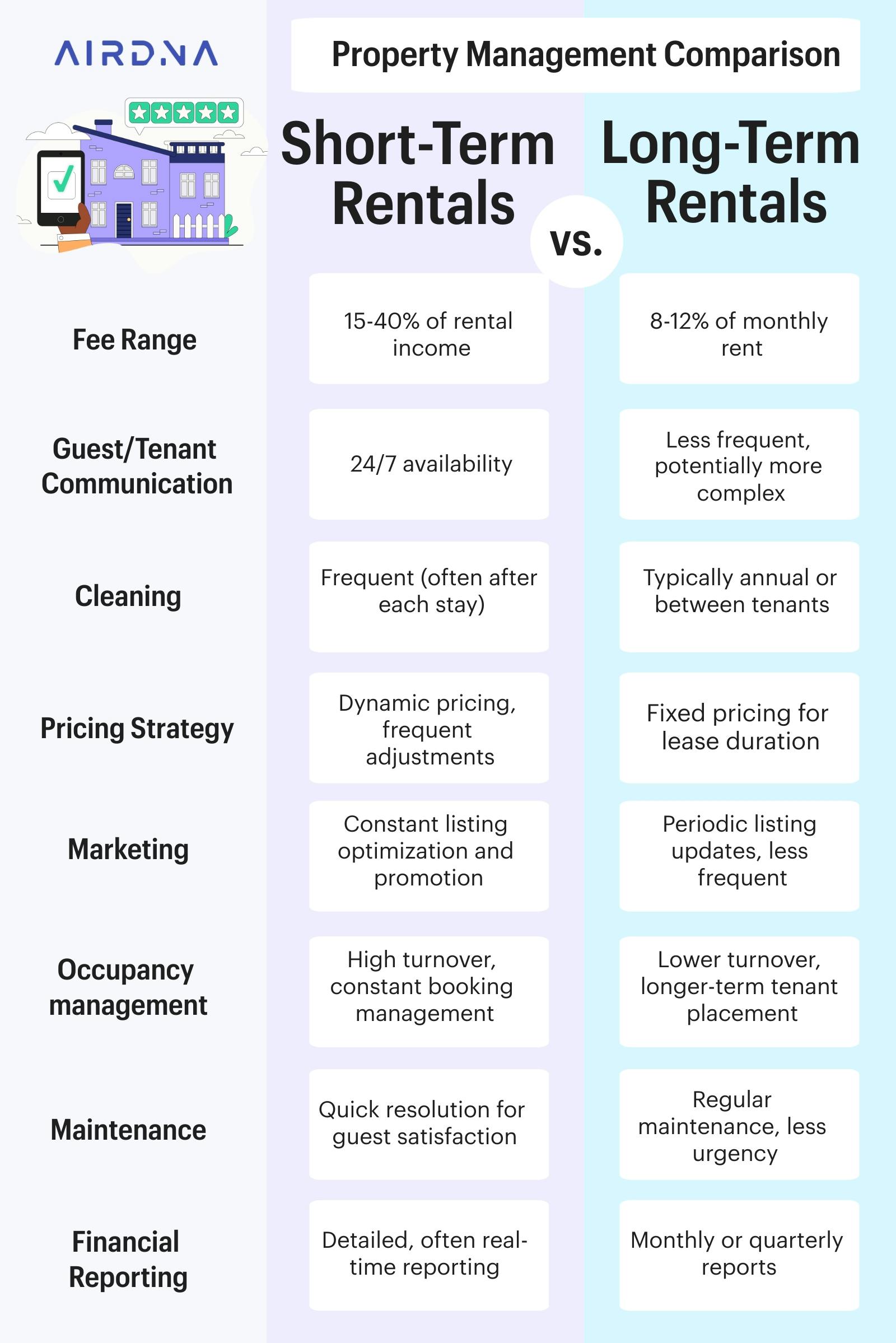
Long-term rental management fees are generally lower due to the more stable nature of long-term tenancies. Short-term rentals require a more hands-on approach, justifying the higher fees charged by management companies.
For a deeper dive into the ROI comparison between Airbnb and long-term rentals, check out our article on Airbnb vs. renting.
How to Choose the Right Property Management Company
Don't fixate solely on the question, "How much does Airbnb management cost?" Instead, approach finding an Airbnb management company like you would a business partner to amplify your property's potential.
Start by defining your goals: boosting occupancy, increasing revenue, or freeing up your time (or maybe all 3!). Evaluate companies based on their ability to meet these needs, not just their fees. Consider each company's value proposition and track record of improving property performance.
During your research, focus on communication style and industry knowledge. A good manager should clearly explain their strategies and justify their fees. Be direct in discussing costs, asking for a breakdown of services and any additional charges.
Remember, the cheapest option isn't always best, nor is the most expensive necessarily most effective. Look for a company that aligns with your values and demonstrates genuine interest in your success.
Key Questions to Ask When Interviewing Property Managers
When meeting with potential Airbnb property managers, ask these important questions:
- What specific services are included in your management fee?
- How do you structure your fees? Are there any additional or hidden charges?
- What's your average occupancy rate for properties similar to mine?
- How do you handle pricing and rate adjustments?
- What's your process for guest screening and communication?
- How quickly do you respond to guest issues or emergencies?
- What's your approach to property maintenance and cleaning?
- How often will I receive financial reports and what do they include?
- Can you provide references from other Airbnb hosts you work with?
- What makes your company stand out from other Airbnb management services?

Red Flags to Avoid
Watch out for these warning signs when evaluating property management agreements:
- Lack of transparency about fees or services included
- Unwillingness to provide references or share performance data
- Inadequate or slow communication during the inquiry process
- Pressure to sign a long-term contract without a trial period
- Unclear policies on damage handling or guest screening
- Lack of experience with Airbnb or short-term rentals
- No clear strategy for marketing or improving property performance
- Restrictive terms on owner stays or property access
- Outdated technology or inadequate reporting systems
- Negative reviews or complaints about guest satisfaction
Is the Cost of Airbnb Management Worth It?
You've got your Airbnb up and running, and now you're wondering if it's time to call in the cavalry. Hiring a property manager can feel like a big leap, but for many hosts, it's the secret to success (and a good night's sleep).
Benefits of property management include:
- Time savings
- Better booking rates
- Local market expertise
- Professional marketing
- Consistent guest experiences
Self-management might be a better option for your short-term rental business if you’re someone who values control, offering a personal touch to the guest experience, and flexibility. If you’re a small-scale operation or you rent out your property infrequently, then the cost savings of managing your own property may outweigh the benefits of a property manager.
Lastly, managing your own Airbnb can be a valuable learning experience if you’re just starting out. Knowing hands-on what it takes to operate a short-term rental can give you a keener understanding of which Airbnb property management services provide the highest value and what a reasonable price point looks like.
Read our article, Do I Need a Property Manager to Rent My Home? 7 Signs It’s Time to Hire Help, for a more in-depth review of the pros and cons of professional management.
How Property Management Systems (PMS) Fit In
Hiring a property manager isn’t the only way to streamline short-term rental operations—property management systems (PMS) can take the place of—or be used in conjunction with—a property manager.
A property manager is a hands-on solution, often providing a full-service experience that lets you step back entirely. This convenience comes at a higher cost, typically ranging from 10% to 30% of your rental income.
A property management system (PMS) is a software tool designed to automate tasks like booking management, pricing, and guest messaging. A PMS like Uplisting is a more budget-friendly option that still requires your involvement but allows for greater control and oversight.
For hosts seeking the best of both worlds, it’s possible to leverage a PMS alongside a property manager. Many professional managers use PMS tools to improve efficiency, and understanding how the two can work together might allow you to negotiate lower management fees. Ultimately, finding the right balance between technology and professional help can maximize your property’s potential without sacrificing your budget.
ARTICLE SUMMARY
You've crunched the numbers, and the answer to "How much do property managers charge?" has left you reeling. With fees gobbling up 20% to 30% of your Airbnb income, you might be tempted to slam the door on the whole idea. Before you do, read this article on everything you need to know about Airbnb property management fees and whether they are worth the investment or just an expensive garnish.
Bram Gallagher
AirDNA Director of Economics and Forecasting
Bram Gallagher is an Economist at AirDNA, specializing in uncovering insights that drive smarter short-term rental decisions. He put his Ph.D. in Economics from the University of Georgia to work researching and forecasting hotel data with CBRE prior to joining AirDNA, as well as teaching economics at a number of universities. In his spare time, Bram enjoys making wooden furniture with hand tools.